What Is The Correct Way To Eat Panettone?
How Milan actually serves panettone: warmed briefly, cut vertically through the dome, paired with specific drinks, and stored properly once the half is left over.
What Is The Correct Way To Eat Panettone?
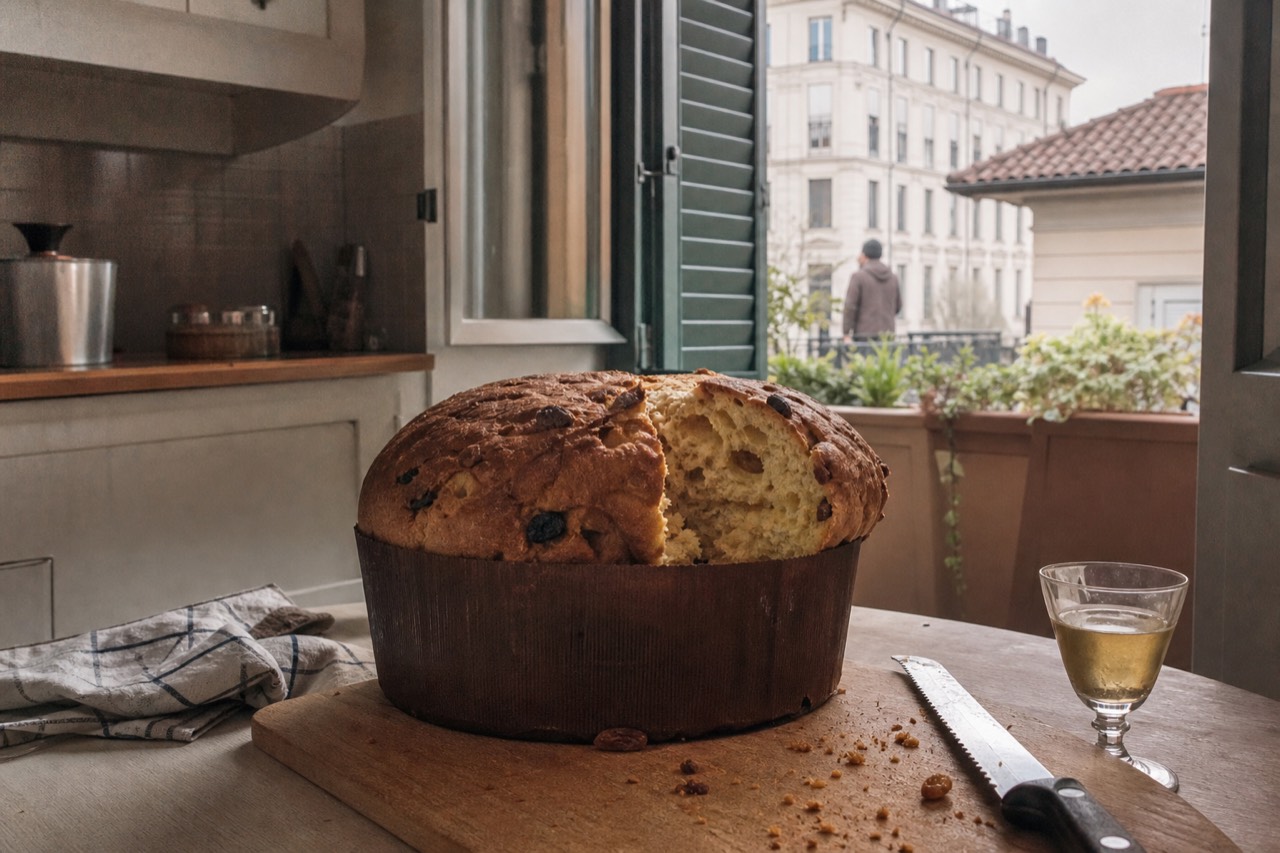
The correct way to eat panettone is to warm it briefly first, then cut it vertically through the dome into tall wedges, never horizontally across the middle. Serve it at the table with a sweet or sparkling wine, or a caffè latte in the morning, and eat the slices with your hands or a small dessert fork. Any leftover half goes back into its paper collar and into a sealed bag.
That is the short answer. The longer one is worth knowing, because panettone is not a sponge cake and it does not behave like one. It is a naturally leavened bread, raised over days by a living sourdough starter, with a crumb that is structured in long, elastic strands. Cut it the wrong way and you crush those strands. Serve it cold from the fridge and the butterfat in the crumb is waxy instead of melting. Treat it like bread rather than cake and nearly everything about it starts making sense.
The warming step matters more than people expect. Ten to fifteen minutes in a low oven, around 100 degrees Celsius, is enough to take the chill off the crumb and let the butter release its aroma. Some Milanese families pass the slice briefly over a toaster or a dry pan. What you are aiming for is warmth, not toast: the moment the edges colour, you have gone past the point.
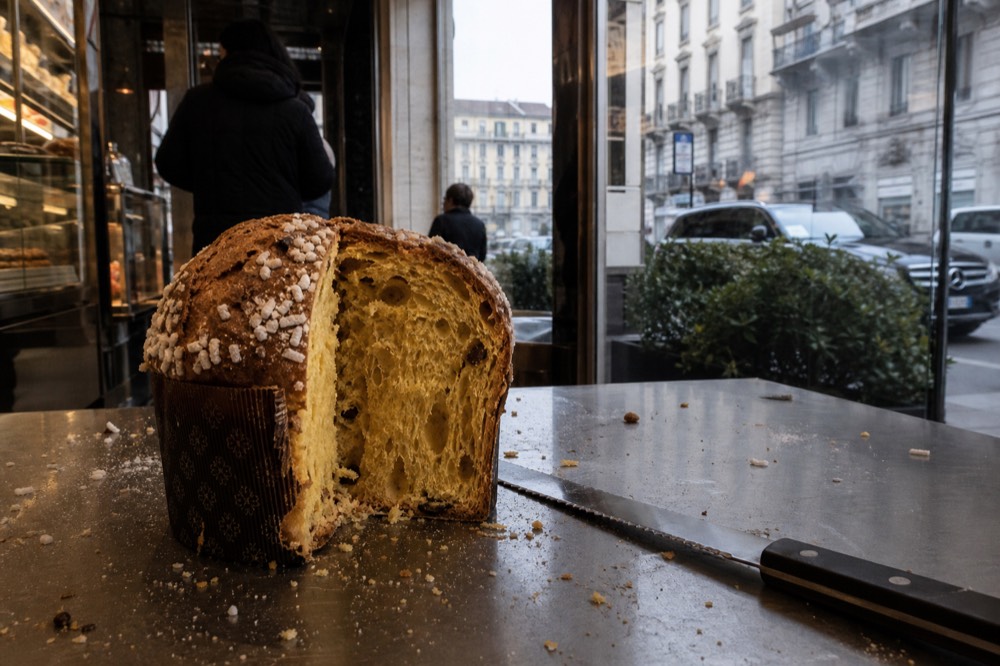
The cut is the part visitors usually get wrong. A panettone is scored into vertical sections by its own paper collar, and the correct method is to cut from the top of the dome straight down, taking a wedge that includes both dome and base. Cutting horizontally, as you would a layer cake, gives you a flat slab that dries out fast and loses the contrast between the tender top and the more structured bottom.
If you want to see how Milan's pastry professionals handle sweet traditions rather than reading about them, these are the three experiences that line up best with this article.
For a separate chocolate-focused outing, the Enrico Rizzi chocolate factory tour offers: a one-hour visit to a working chocolate laboratory with a tasting at the end, from $35 per person, rated 4.6 across 68 reviews, with free cancellation up to 24 hours. The meeting point is the Fabbrica del Cioccolato at Via Gian Giacomo Mora 18, and the listing suggests the M4 De Amicis metro stop as the way in. It is a short, inexpensive way to watch someone who treats Milanese confectionery as a craft.
What Should You Drink With Panettone?
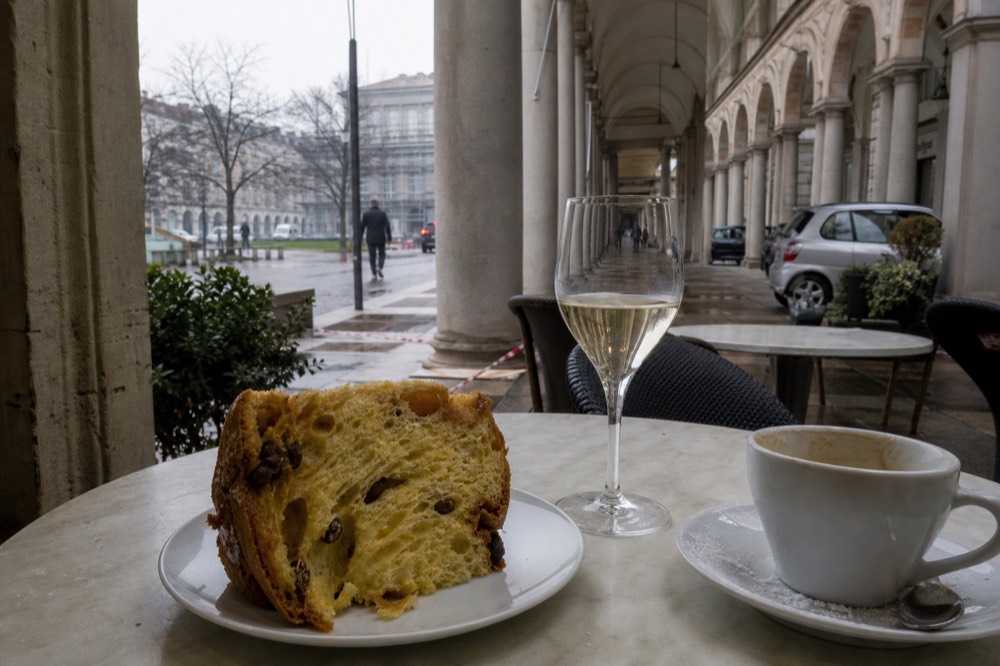
The classic Milanese pairings are a sweet sparkling wine such as Moscato d'Asti or a Passito alongside panettone in the evening, and caffè latte or cappuccino with it at breakfast. Dry red wine fights the fruit and the butter, and espresso overwhelms the delicate sourdough aroma. Sweet wine is the traditional choice because the wine's sweetness meets the cake's rather than competing with it.
The evening pairing is the older tradition. Panettone ends the Christmas Day meal in most Milanese homes, and the bottle opened with it is almost always sweet and usually fizzy. Moscato d'Asti is the common one, low in alcohol and lightly sparkling. A Passito, or a Marsala for those who like something heavier, also works. The logic is simple: a dry wine tastes thin and acidic next to a slice whose crumb carries candied fruit, raisins and a high proportion of butterfat.
Morning is a different story. A slice of panettone with caffè latte, dunked briefly, is a legitimate Milanese breakfast in December, not a tourist invention. The milky coffee softens the crumb without drowning the aroma. What you will not see locally is panettone with a post-dinner espresso: the coffee is too intense and too bitter for the delicate leavened flavour, and by that point in the meal the sweet wine has already been poured.
| Panettone variant | Best drink pairing | Serving temperature |
|---|---|---|
| Classic with raisins and candied citrus | Moscato d'Asti or Passito | Warm, 10-15 minutes in a low oven |
| Chocolate chip | Marsala or a sweet red Passito | Warm, same method |
| Pistachio cream filled | Caffè latte or a sweet sparkling wine | Slightly cool, so the cream holds |
| Plain artisan (no filling) | Cappuccino at breakfast | Warm, this is the variant that most rewards it |
Filled and glazed industrial variants behave differently. A pistachio-cream filled panettone is better slightly cool, because the filling turns greasy when heated. An artisan classic, with nothing but raisins, candied peel, butter and eggs, is the one that most rewards the warming step.
If this article has you planning a Milan trip around the city's sweet traditions, the chocolate factory tasting is an easy addition to any itinerary.
How Do You Store The Leftover Half?
Store the leftover half of a panettone inside its paper collar, inside a sealed bag, at cool room temperature, and it will keep for several days. Never refrigerate it: the fridge stales the crumb and kills the aroma within a day. An artisan panettone keeps longer than an industrial one because its high butterfat and low water content preserve it naturally.
The paper collar is not just packaging. It supports the walls of the cut face and slows the loss of moisture from the exposed crumb. Slide the whole thing, collar and all, into a large freezer bag or wrap it in film, press out the air, and leave it in a cool cupboard or pantry. A naturally leavened artisan loaf treated this way stays good for a week or more after opening, and some bakers argue it improves for the first two or three days as the aromas settle.
The fridge is the enemy. Refrigeration sets the butterfat into a waxy state and the crumb goes dry and crumbly within about a day. If your kitchen is genuinely warm, above 24 degrees, a short fridge spell is the lesser evil, but bring the slice back to room temperature or warm it briefly before eating.
For longer keeping, freezing works well. Wrap wedges individually in film and foil and freeze them; a frozen slice will revive almost perfectly with ten minutes in a low oven. This is also the answer to the post-Christmas problem of a half-eaten one-kilo loaf: freeze the wedges now, and you have warm panettone for breakfast in February.
Leftover panettone that has gone slightly dry is not waste. Milanese cooks slice it, lightly toast it, and serve it with mascarpone cream, or soak it and use it in a bread-and-butter style pudding. Stale panettone French toast is a common December breakfast in the city's cafés.
What Actually Makes A Panettone A Panettone?
Italian law defines panettone by the Decreto 22 luglio 2005, a national sale-name decree published in Gazzetta Ufficiale n. 177 of 1 August 2005. To carry the name, the product must be naturally leavened from sourdough and contain at least 4% egg yolk, 16% butterfat and 20% raisins and candied citrus peel. It is not a DOP or IGP protected designation; it is a production standard any producer can meet.
This is the part most English-language writing gets wrong, so it is worth being precise. Panettone has no EU protected designation of origin. What it has is a sale-name decree, which says that anything sold in Italy under the name panettone must meet a defined production standard. The full text is published in the official Gazette, and the requirements are specific: natural fermentation from a sourdough starter, a minimum of four per cent egg yolk, sixteen per cent butterfat, and twenty per cent combined raisins and candied citrus peel.
The decree also defines pandoro, and the contrast is instructive. Pandoro must carry at least twenty per cent butterfat but has no fruit requirement at all, which is why it is the plain, star-shaped, sugar-dusted alternative on Italian Christmas tables. The two minimums sit side by side in the same article of the same law.
| Requirement | Panettone | Pandoro |
|---|---|---|
| Natural sourdough leavening | Required | Required |
| Minimum butterfat | 16% | 20% |
| Minimum egg yolk | 4% | Not specified in the same terms |
| Minimum raisins and candied citrus | 20% | None |
| Typical shape | Round base, domed top, cracked crust | Eight-pointed star |
| EU DOP or IGP status | None | None |
At the municipal level, Milan does something different again. The Comune di Milano maintains its own De.Co. register, a denominazione comunale that recognises products as belonging to the city's territory, and panettone has been on it since 2007. The Comune describes the register as a statement of territorial belonging, not an EU-style quality guarantee, and the full list, which also includes risotto alla milanese, michetta and the newly added Pan de Mej, is published on the city's food policy pages. So the honest hierarchy is: a national production decree that defines what the word means, and a municipal register that ties it to Milan.
There is also a wider context that changed recently. Italian cuisine as a whole was inscribed on UNESCO's Intangible Cultural Heritage list on 10 December 2025, the first entire national cuisine to receive the designation, a decision taken unanimously by the committee in New Delhi and reported by CNN. Panettone sits inside that tradition, but its own protection remains the 2005 decree, nothing more.
How Much Should A Real Panettone Cost?
An artisan panettone in Milan cost above EUR 50 per kilo in the 2025 season, according to an analysis by Resmart reported by Food Affairs, which named Marchesi and Gattullo both at EUR 50 per kilo and reported a 55% rise over five years. Industrial supermarket panettone sells for a small fraction of that. The price gap reflects ingredients, fermentation time and skilled labour, not branding alone.
The 55% five-year rise is the figure worth holding onto. It comes from a named analysis of Milan pastry shops, and it reflects what has happened as demand for naturally leavened, long-fermented loaves has grown while supermarket versions have stayed cheap. A one-kilo artisan loaf from a historic Milan pasticceria now costs roughly what a restaurant main course costs.
| Type | Price per kilo, Milan 2025 season | What you get |
|---|---|---|
| Artisan, historic pasticceria (Marchesi) | EUR 50, per Food Affairs/Resmart | Sourdough fermentation, high butterfat, hand-shaped |
| Artisan, historic pasticceria (Gattullo) | EUR 50, per Food Affairs/Resmart | Same class of production |
| Industrial supermarket loaf | A small fraction of artisan price | Brewed or industrial yeast, lower minimums met, uniform crumb |
Why the gap? Time, mostly. A true sourdough panettone takes two to three days from starter to finished loaf, with multiple slow proofs, and the dough is fragile and temperature-sensitive throughout. Industrial versions use faster leavening and cheaper fats in some markets outside Italy, though anything sold in Italy under the name must still meet the decree minimums. The result is that even a cheap Italian supermarket panettone is a legitimately defined product; it is simply not the same eating experience as the artisan one.
The practical advice follows from this. If you are buying in Milan for a gift or a table, the artisan loaf justifies its price on the first day and keeps justifying it for a week. If you are buying to try the tradition cheaply, a supermarket classic still meets the legal definition and costs little. What is worth avoiding is paying artisan prices for a glazed, cream-filled novelty, which is a different product category entirely.
If your interest in Milanese sweets extends past panettone season, the patisserie walk by Do Eat Better is a good fit: a 2.5-hour guided sweets walk from $65.07 per person, rated 4.8 across 59 reviews, with free cancellation up to 24 hours. The listing shows it is booked 46 days ahead on average, so it rewards planning.
The meeting point is Largo Guido Donegani 105, a short walk from the Duomo area, and the tour covers a series of historic pastry shops in the centre. It is the closest thing on the roster to a guided version of this article's subject.
Common Questions About Eating Panettone
What Is The Correct Way To Eat Panettone?
Warm it briefly, about ten to fifteen minutes in a low oven, then cut it vertically through the dome into tall wedges. Serve with a sweet sparkling wine in the evening or caffè latte at breakfast, and store the leftover half in its paper collar inside a sealed bag at room temperature.
Do You Eat Panettone With Your Hands Or A Fork?
Both are acceptable. At a formal table, a small dessert fork is used. In a Milanese home, a wedge held in the hand is completely normal, especially at breakfast. The wedge shape from a vertical cut is designed to be held.
Should Panettone Be Served Warm Or Cold?
Warm, or at least at cool room temperature. The butterfat in the crumb is waxy when refrigerated and only releases its aroma when the slice is slightly warmed. Ten minutes in a low oven is enough; direct toasting changes the character entirely.
Is Panettone A DOP Product?
No. Panettone has no EU DOP, IGP or STG designation. It is defined by a national sale-name decree from 2005 that sets minimums for butterfat, egg yolk and fruit and requires natural sourdough leavening. Milan's De.Co. register recognises it as a municipal product, which is a territorial recognition, not an EU protection.
How Long Does An Opened Panettone Keep?
An artisan loaf kept in its paper collar inside a sealed bag at room temperature stays good for a week or more. Do not refrigerate it. Wedges can be wrapped and frozen for months and revived with ten minutes in a low oven.
Why Is Artisan Panettone So Expensive?
Because of time and skill. A true sourdough panettone takes two to three days of staged fermentation, and the dough is fragile throughout. In the 2025 season, artisan loaves in Milan were selling above EUR 50 per kilo, against a small fraction of that for industrial versions.
For more on the city's food traditions, Milan Food Tours covers everything from street food walks to home cooking classes, and the guide to panettone in Milan goes deeper on where to buy the best loaves in the city.
Milan: Sweet Delights Patisserie Tour By Do Eat Better
Have your travel date in mind? Check the panettone and patisserie walk before arranging the rest of your Milan food itinerary.
2 hours 30 minutes · en, it · Meet your guide for the Do Eat Better Experience Milan Patisserie Food Tour near the fountain.
Scheduled departure dates. Availability and final price are confirmed on Viator.
None of these experiences matches that choice. Adjust your preference or reset to the general recommendation.
Compare Options And Plan Your Visit
- Taste panettone on a pastry walk
- Panettone appears explicitly in 51159P11 itinerary.
Before Booking
Moderate physical fitness Not suitable for severe or life-threatening food allergies Tastings vary by season and availability
Compare complete party totals in the same currency, including any transport, meals or extras you would otherwise buy.