Panettone In Milan: What The Label Legally Means, What It Costs, And Where To Eat It
Milan's most exported food is also its most misunderstood. Panettone has no EU protection at all, and no Milanese dish does. What it has is a national production decree, a municipal designation, and a price tag that has climbed 55 percent in five years.
Short answer
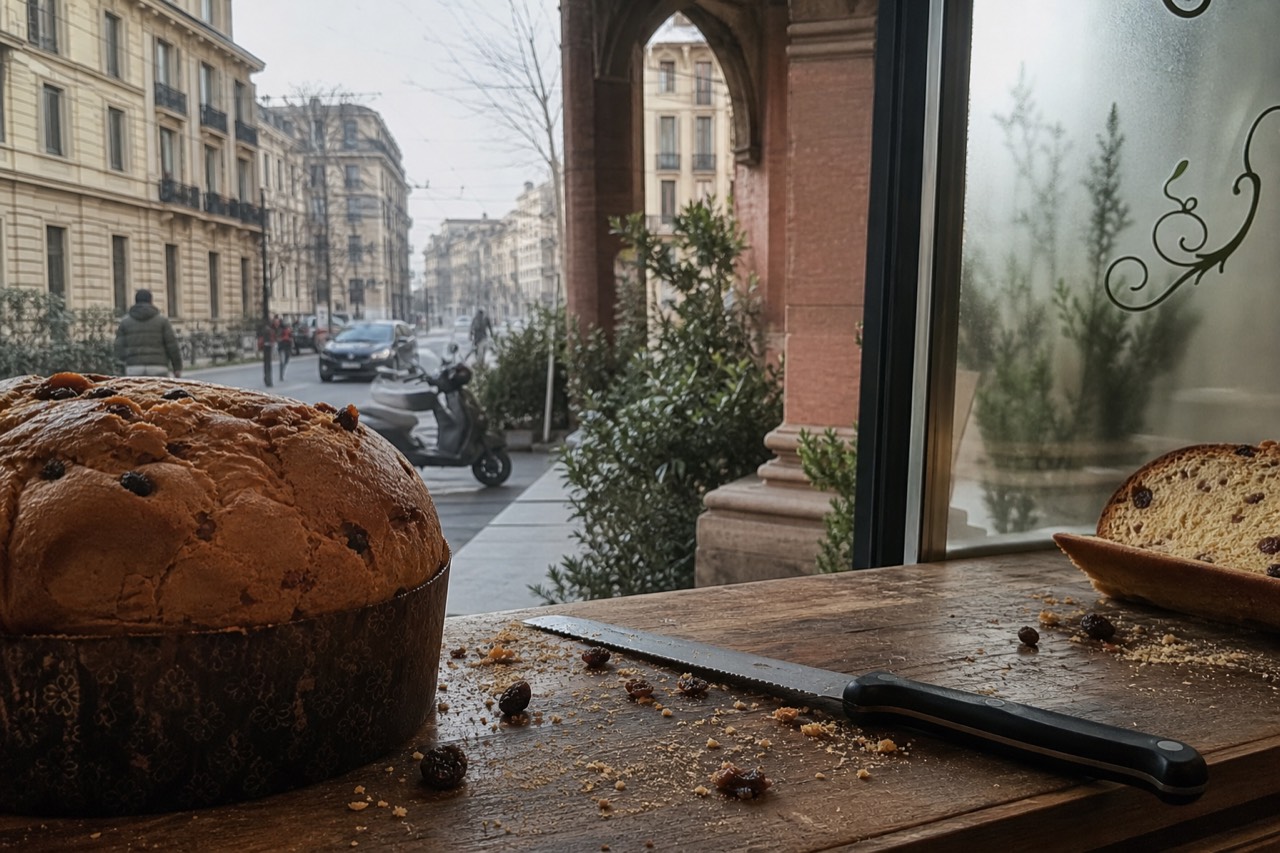
Panettone is not DOP or IGP; no Milanese dish holds EU protection. The name is reserved by a 2005 Italian decree to a sourdough-leavened cake with at least 16% butterfat, 4% egg yolk and 20% raisins and candied peel. Artisan panettone in Milan topped EUR 50 per kilo in the 2025 season.
Panettone is the one Milanese food the whole world thinks it knows. The tall, domed, paper-wrapped cake appears in supermarkets from Tokyo to Toronto every December, which is exactly the problem: most of what is sold under that name worldwide has only a loose connection to what is baked in Milan, and almost none of the folklore about its legal status is true. The cake is not DOP. It is not IGP. No Milanese dish holds any EU protection, and no application for one exists at any stage. What panettone has instead is a national sale-name decree from 2005, a municipal De.Co. entry from 2007, and a small group of Milan pasticcerie that still ferment their own dough. This guide from Milan Food Tours separates the law from the legend, then gets practical: what a real one costs by the kilo, where to eat it in Milan, and what the city bakes during the eleven months when panettone is out of season.
What Is Panettone, Legally Speaking?
Panettone is a sale name reserved by Italian national law, Decreto 22 luglio 2005, published in Gazzetta Ufficiale n. 177 of 1 August 2005, for a soft-dough cake leavened exclusively by natural sourdough, round-based, with a cracked top crust, an elongated open crumb, and minimum quantities of butterfat, egg yolk, raisins and candied citrus peel written into the decree itself. That is the whole of the legal protection, and it is national, not European: the decree binds anyone selling a product called panettone in Italy, but it is not an origin designation and says nothing about where the cake is made.
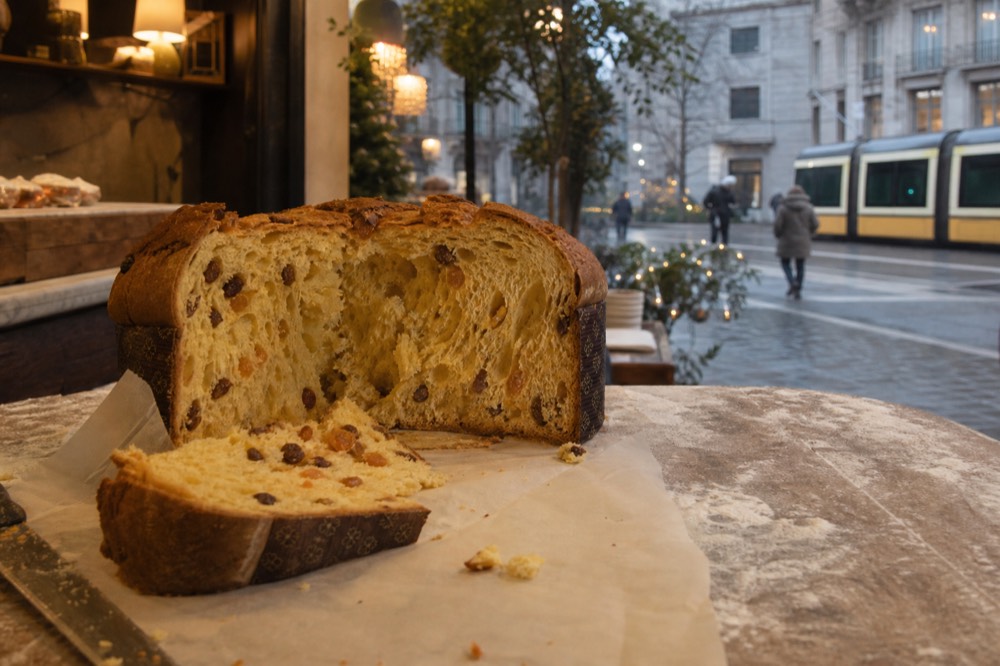
The decree's text is unusually specific for a food law. Article 1 reserves the name to a product obtained by natural fermentation from sourdough, what Italian bakers call pasta acida or lievito madre, and it sets three floors that matter: butterfat not less than sixteen per cent, egg yolk in a quantity guaranteeing not less than four per cent, and raisins and candied citrus peel together not less than twenty per cent. Salt, wheat flour and sugar complete the base. A short list of optional additions is permitted, including honey, malt, cocoa butter, a limited amount of yeast, emulsifiers and two preservatives, sorbic acid and potassium sorbate. The full text sits in the official Gazzetta Ufficiale PDF, pages 37 to 40 of that issue.
The same issue defines pandoro, and the contrast is the cleanest way to understand what the decree is doing. Pandoro must carry not less than twenty per cent butterfat, higher than panettone's floor, but it carries no raisin, peel or yolk minimums because it is a plain, star-shaped, butter-rich cake. Two names, two legal recipes, both protected as sale names rather than as products of a place.
| Requirement | Panettone (DM 22 July 2005) | Pandoro (same decree, Art. 2) |
|---|---|---|
| Leavening | Natural sourdough (pasta acida) only | Natural sourdough or permitted yeast |
| Butterfat minimum | 16% | 20% |
| Egg yolk minimum | 4% | None specified |
| Raisins and candied citrus peel | 20% minimum combined | Not part of the recipe |
| Shape | Round base, cracked top crust, elongated open crumb | Star-shaped section, no crust |
| Permitted preservatives | Sorbic acid, potassium sorbate | Sorbic acid, potassium sorbate |
One honest caveat: the decree was reportedly amended by DM 16 maggio 2017, adjusting the egg and butter categories, but that amendment was not verified against the decree text itself, so it is context here rather than citation. The 2005 decree as published is the hard, checkable law.
Is Panettone DOP, IGP Or Protected In Any Way?
No. Panettone holds no EU designation of any kind, no DOP, no IGP, no STG, and no application for one has been found at any stage. What Milan's panettone does hold is a De.Co. entry from 2007, a municipal recognition the Comune di Milano describes as a statement of territorial belonging, not a quality or origin guarantee in the EU sense. This is the single most repeated error in food writing about Milan, and it runs in both directions: guides claim protection that does not exist, and sceptics conclude the cake is legally meaningless, which is also wrong.
The De.Co. register, the Registro dei prodotti alimentari a Denominazione Comunale, was created by two resolutions of Milan's city government, n. 3057 of 14 December 2007 and n. 620 of 2008. Panettone, michetta, cassoeula, risotto alla milanese and ossobuco went on in 2007; cotoletta alla milanese, mondeghili, rostin negaa and barbajada followed in 2008. The Comune's own food policy pages carry the register, and they are blunt about what it is: an attestation of belonging to a territory. A baker in Buenos Aires making a 16 percent butterfat sourdough cake can legally call it panettone; the De.Co. entry simply says the Milanese version belongs to Milan.
| Product | De.Co. year | Notes |
|---|---|---|
| Panettone | 2007 | Tied to the festive calendar |
| Michetta | 2007 | Milan's signature bread roll |
| Cassoeula | 2007 | Winter pork and cabbage stew |
| Risotto alla milanese | 2007 | Saffron risotto |
| Ossobuco | 2007 | Braised veal shank |
| Minestrone alla milanese | 2008 | |
| Cotoletta alla milanese | 2008 | |
| Mondeghili | 2008 | Fried leftover-meat croquettes |
| Rostin Negaa | 2008 | |
| Barbajada | 2008 | Historic chocolate-coffee drink |
| Pan de Mej (Pan Meino) | 2026 | Newest entry, tied to 23 April |
The wider context makes the absence more striking, not less. Italian cuisine as a whole was inscribed on UNESCO's Intangible Cultural Heritage list on 10 December 2025, the first entire national cuisine to receive the designation, by unanimous decision of the committee meeting in New Delhi, as CNN reported. And the cheeses that Milanese kitchens actually use, Gorgonzola and Grana Padano, both hold real DOP status, Gorgonzola producing a record 5,421,517 wheels in 2025. So the pattern in Milan is inverted from what visitors expect: the famous cake has the weakest legal footing on the table, and the cheese beside it has the strongest.
If the legal reality changes how you shop, the practical takeaway is simple: look for pasta acida or lievito madre on the label, look for a pasticceria name you can visit, and treat the word "artisanale" as a claim to check rather than a guarantee. For a fuller run through the city's sweet landscape, our guide to Milan's famous desserts covers the rest of the counter.
What Is The Best Panettone Brand In Italy?
There is no official best, and any listicle claiming one is ranking by taste rather than law. The honest answer is by criterion: for sourdough tradition inside Milan, the historic pasticcerie that ferment their own lievito madre lead; for consistency at scale, the large industrial producers win on price and availability; for a Milan trip, the best panettone is the one baked in a shop you can walk into. The decree's minimums are met by everyone, so the difference is entirely in the fermentation and the fruit.
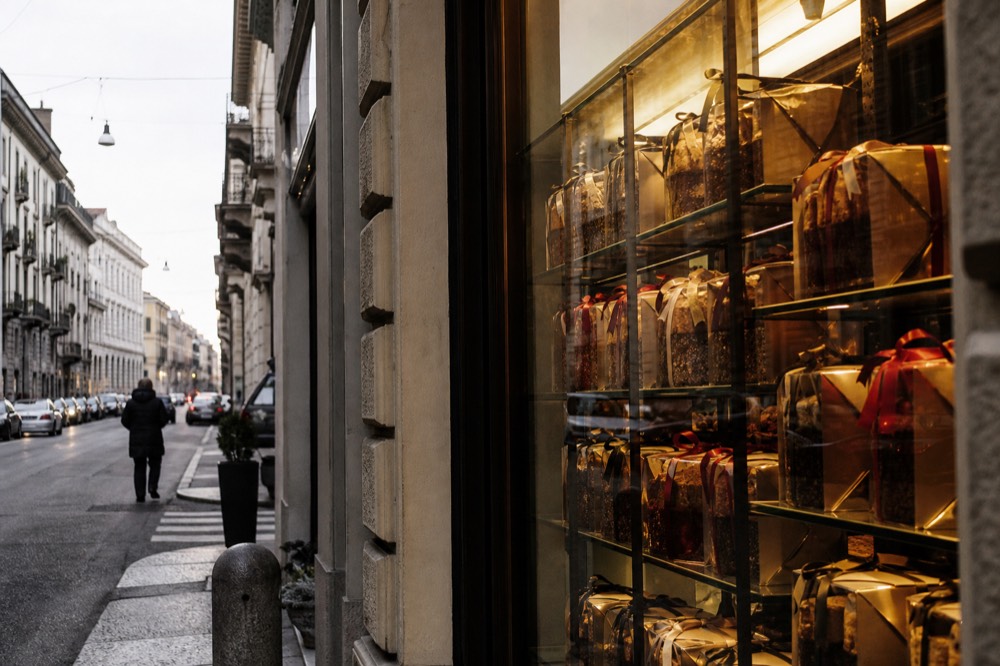
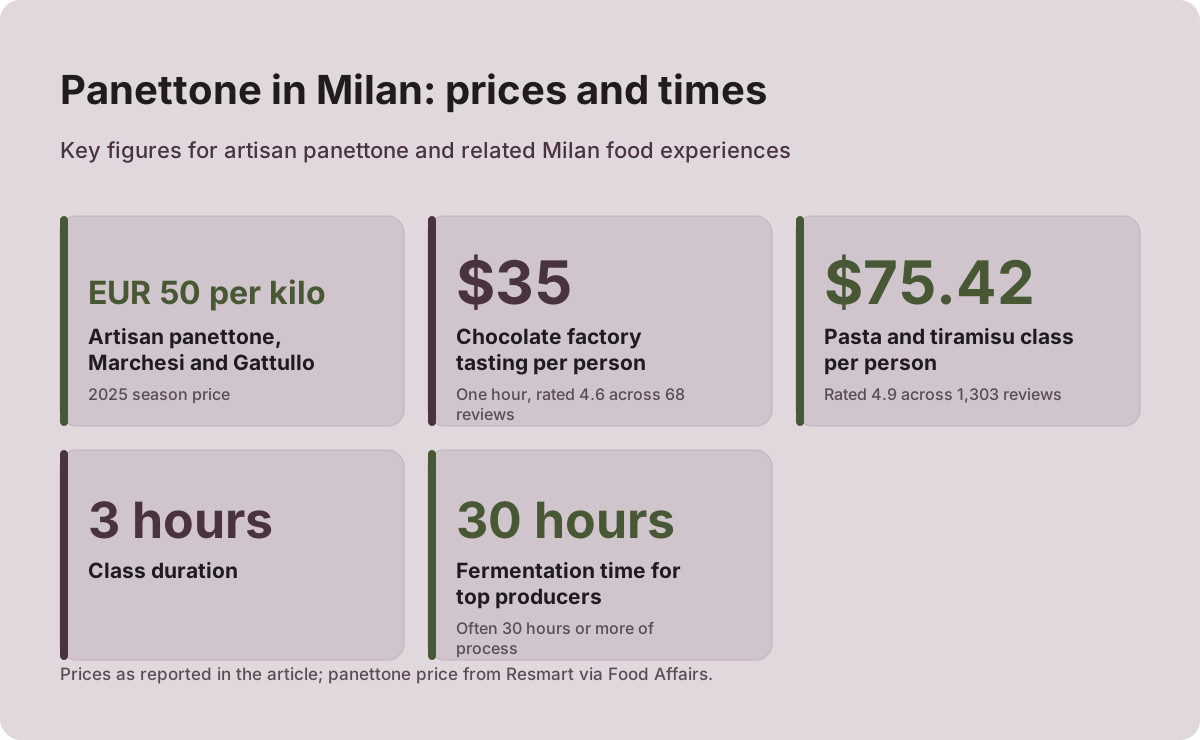
Start with what the label can tell you. Every panettone legally sold in Italy meets the 2005 minimums, so a EUR 12 supermarket cake and a EUR 60 artisan one share the same legal floor. The divergence is above the floor: the best producers use only natural sourdough over long fermentation, often 30 hours or more of process, higher-quality butter than the 16 percent minimum, and candied fruit cut from whole peel rather than reconstituted. Industrial producers, the brands most visitors already know by name, deliver reliability and shelf life, and there is nothing shameful about them; they simply occupy a different tier.
Inside Milan the names that come up again and again in local reporting are the ones with their own ovens: Marchesi, Gattullo, and the small circle of pasticcerie that appear in the annual price surveys. A useful habit is to ask whether the shop bakes on site; a pastry shop that makes its own panettone will say so prominently, because the labour is enormous and the season is short. If you want the question settled by eating rather than reading, a guided walk through the city's sweet shops turns the comparison into an afternoon.
The chocolate side of Milan's confectionery tradition is easier to taste on demand, because chocolate has no season. Enrico Rizzi's Fabbrica del Cioccolato runs a one-hour factory tasting in central Milan, from $35 per person, rated 4.6 across 68 reviews, with free cancellation up to 24 hours ahead. The factory sits at Via Gian Giacomo Mora 18, with the M4 De Amicis stop given as the way in.
For travellers who would rather make the dessert than rank it, the hands-on route is strong: a pasta and tiramisu class at a local host's home runs 3 hours from $75.42 per person, rated 4.9 across 1,303 reviews, with the same 24-hour free cancellation. Tiramisu is a separate dessert and the class teaches its own preparation skills, not panettone fermentation.
How Much Does A Real Panettone Cost In Milan?
Artisan panettone in Milan sold above EUR 50 per kilo in the 2025 season, with Marchesi and Gattullo both named at EUR 50 per kilo in an analysis by Resmart reported by Food Affairs, which also headlined a 55 percent rise over five years. Those figures belong to that reporting, not to us, but the direction is confirmed by everything else on the Milan price spectrum. A one-kilo artisan cake is now a EUR 50 to EUR 60 purchase in the top tier, and the gap between tiers is wide.
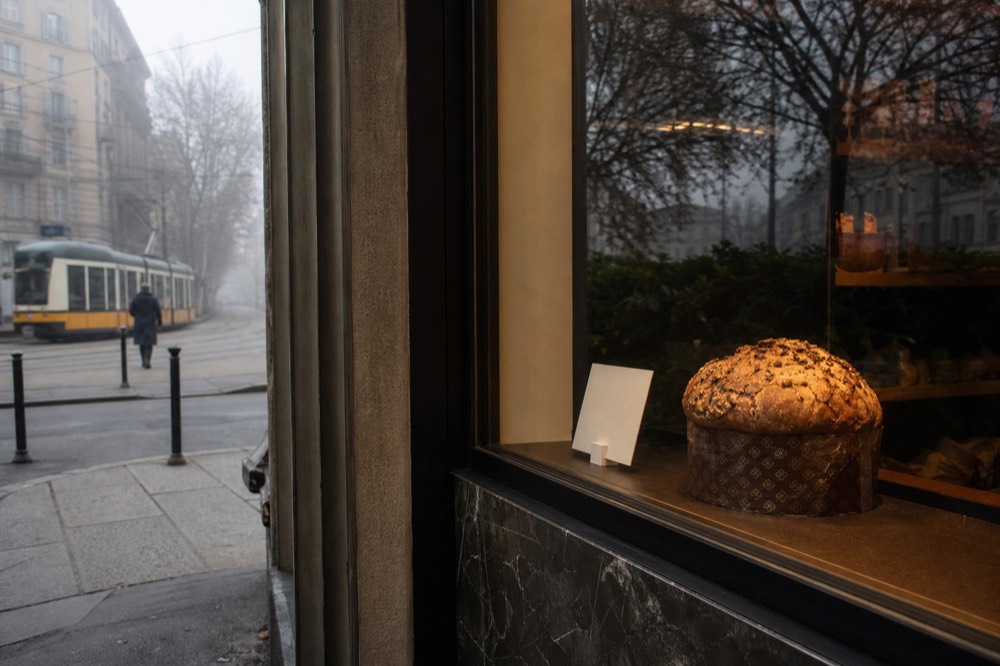
The price ladder in Milan runs roughly like this. Industrial panettone from supermarkets starts low and falls further after Christmas Eve. Mid-tier branded cakes from known producers sit in the middle. The artisan tier, the shops with their own lievito madre, is where the EUR 50 per kilo figure lives, and where the five-year climb has been steepest. The reasons are honest ones: butter, eggs and candied peel have all risen, and a natural sourdough cake cannot be rushed, so the labour cost is fixed.
| Tier | Where you buy it | Ballpark per kilo | What you are paying for |
|---|---|---|---|
| Industrial | Supermarkets, big-box | Lowest tier, discounted after 24 December | Consistency, shelf life, the legal minimums |
| Branded mid-tier | Delis, some cafés | Mid range | Name recognition, better fruit, stable quality |
| Artisan Milan | Historic pasticcerie with own ovens | EUR 50 and above | Sourdough fermentation, hand-work, short season |
Two practical notes for buyers. First, weight matters more than box size: compare prices per kilo, not per box, because formats vary widely and the per-kilo figure is the only honest comparison. Second, timing cuts both ways: the full artisan range appears from late October, but the best shops sell out before Christmas rather than discount after it, so waiting for January sales only works at the industrial tier. For how the city's price levels compare across eating out generally, our piece on whether eating out in Milan is expensive sets the wider context.
Where Should You Eat Panettone In Milan?
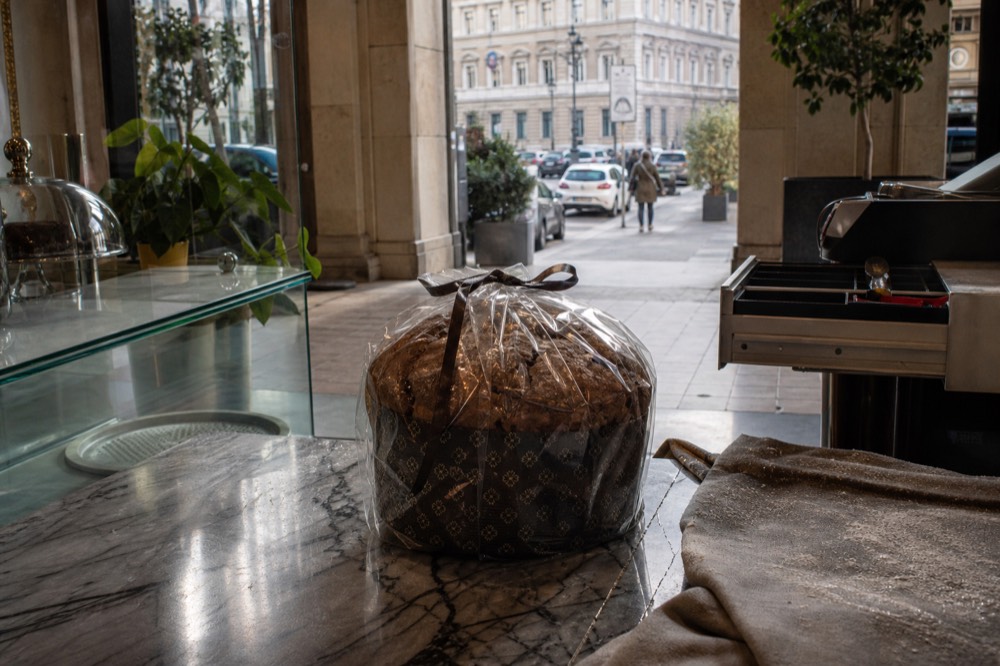
Eat it where it is baked: the historic pasticcerie that ferment their own sourdough and sell the cake in season, ideally between late October and Christmas, with Marchesi and Gattullo the two names the price reporting keeps returning to. Outside those months, the honest answer is that most pastry shops stop making it, and the boxed versions on sale are industrial stock, so plan a panettone tasting as a strictly seasonal errand. Milan is not a year-round panettone city, and pretending otherwise leads to disappointment.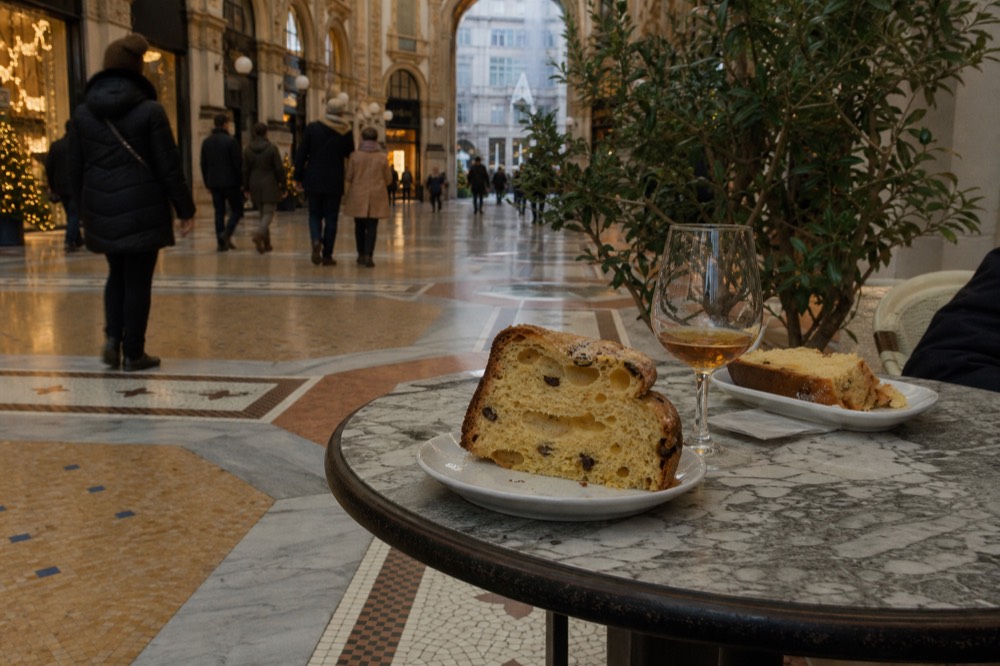
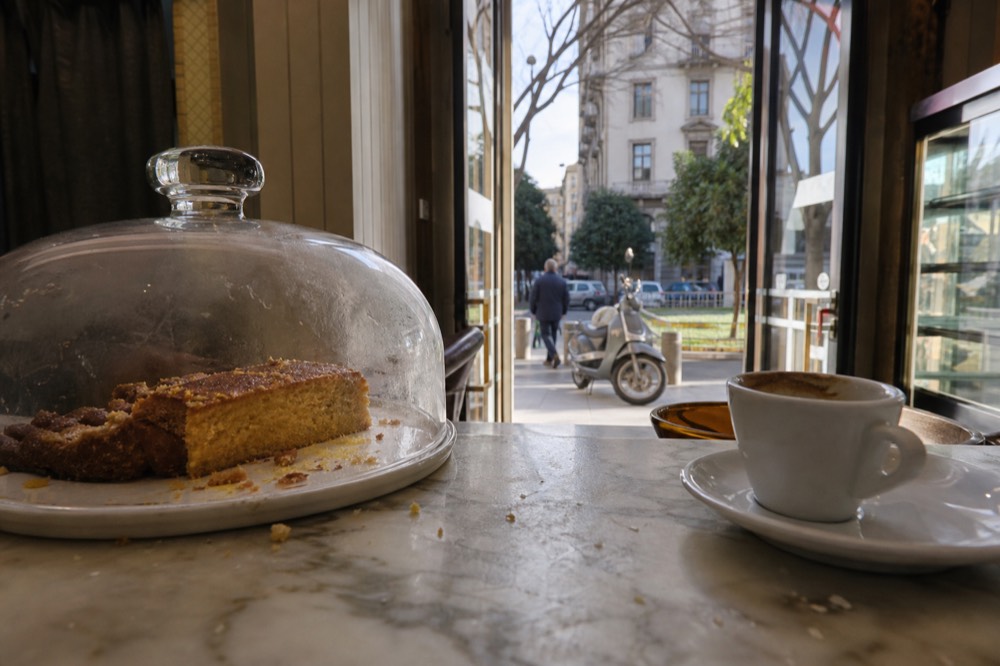
The season is short by design. The De.Co. entry ties panettone explicitly to the festive calendar, and the pasticcerie treat it that way: production ramps through November, peaks in the two weeks before Christmas, and stops. What this means for a visitor is that a December trip is not just the best time for panettone, it is effectively the only time. A March visitor can still buy boxed industrial cakes, and some delicatessens carry them, but the fresh-from-the-oven experience does not exist in spring.
Pair the errand with the neighbourhood. The historic pastry shops cluster in the centre and in Navigli, and a morning walk that takes in two or three of them, tasting a slice at each, is the closest thing Milan has to a self-guided panettone crawl. If you would rather have someone else arrange the route and the tastings, a guided sweets walk does exactly that: the Sweet Delights patisserie tour by Do Eat Better runs 2 hours 30 minutes from $65.07 per person, rated 4.8 across 59 reviews, meeting at Largo Guido Donegani 105, and the listing shows it is booked 46 days ahead on average, so December dates go early.
For the full picture of where Milan's best counters are, our guide to the best gelato in Milan covers the year-round half of the city's sweet geography, and the food markets guide covers where the raw ingredients, from butter to candied peel, are traded.
What Do You Eat When Panettone Is Out Of Season?
Eat Pan de Mej. Milan added it to the De.Co. register in 2026, the newest entry on the list, and the Comune's own register ties it to the feast of San Giorgio on 23 April, making it the city's only classic sweet with a fixed spring date and the natural successor to panettone in the Milanese baking calendar. It is a soft, yellow cornmeal cake, traditionally scented with elderflower, and almost no guide to Milan mentions it at all.
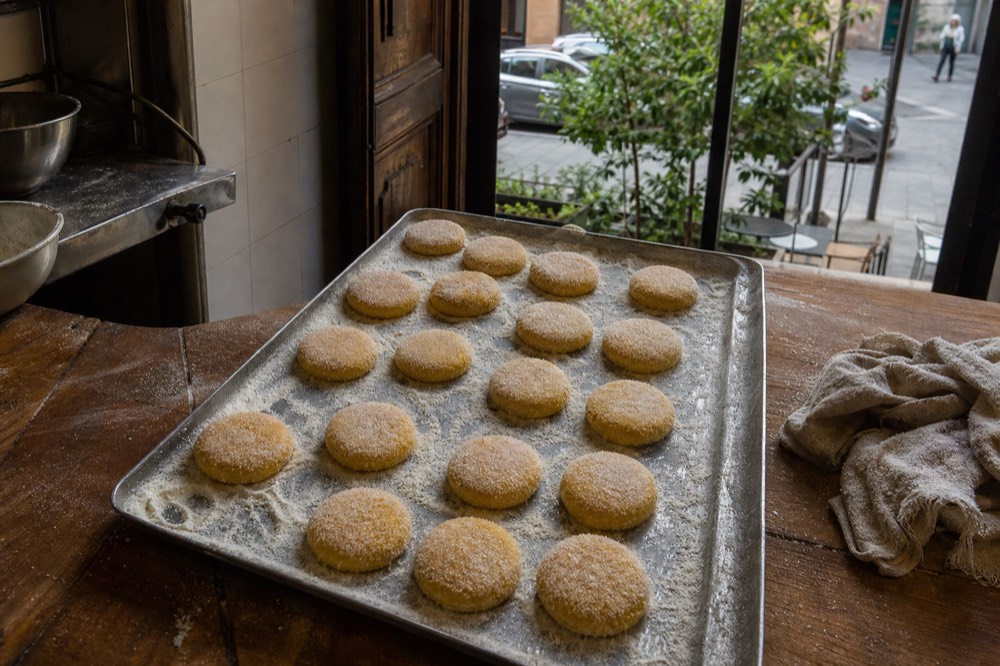
The seasonal logic of Milan's pastry counters runs quietly through the year. Panettone owns late October to Christmas. Pan de Mej owns late April, appearing in the pasticcerie around San Giorgio. Between and beyond them, the city's standard sweet repertoire holds the rest of the calendar: the dessert traditions covered in our dessert guide, the gelato counters, and the chocolate makers, whose output never stops. That last point is worth underlining for off-season visitors: a February or July trip cannot taste fresh panettone at its source, but it can taste Milan's chocolate tradition any week of the year, and the factory tasting near the Navigli area runs hourly slots year-round.
There is also a making-versus-buying answer to the off-season problem. The techniques behind Milan's desserts, the folding, the layering, the patience with dough and cream, are teachable in any month, and the city's cooking class calendar runs all year. The 3-hour class at a local host's home, from $75.42 per person, rated 4.9 across 1,303 reviews, is the most-booked example, and its 24-hour free cancellation makes it easy to slot around a seasonal itinerary.
A final seasonal note for planners: if your trip lands in the Christmas run-up, book the pastry-related experiences early. The patisserie walk's average 46-day booking lead time and the chocolate factory's compact one-hour format both mean December slots thin out well before the panettone itself does.
The questions below cover the legal status, the price, the season and the off-season alternatives in one place, with every figure drawn from the decree, the De.Co. register or the named 2025 price reporting. If you are deciding what to buy, read the brand question first; if you are deciding when to come, read the season one.
Common Questions About Panettone In Milan
What Is The Best Panettone Brand In Italy?
There is no official ranking. Judge by criterion: sourdough fermentation and own-oven production put the historic Milan pasticcerie, including Marchesi and Gattullo, in the artisan tier; industrial brands win on consistency and price. Every panettone legally sold in Italy meets the 2005 decree's minimums, so the real differences are fermentation time, butter quality and fruit.
Is Panettone DOP Or IGP Protected?
No. Panettone holds no EU designation, and no application for one has been found at any stage. It is protected as a sale name by the Italian Decreto 22 luglio 2005, which sets recipe minimums but says nothing about where the cake is made. Milan's panettone also carries a De.Co. entry from 2007, a municipal recognition only.
How Much Does Artisan Panettone Cost In Milan?
Artisan panettone in Milan sold above EUR 50 per kilo in the 2025 season, with Marchesi and Gattullo both named at EUR 50 per kilo by Resmart analysis reported by Food Affairs, which also reported a 55 percent rise over five years. Industrial and mid-tier cakes cost considerably less.
When Is Panettone Season In Milan?
Roughly late October through Christmas. The De.Co. register ties panettone to the festive calendar, and pasticcerie that bake their own stop after the holidays. Outside the season, fresh artisan panettone is simply not available; only boxed industrial stock is.
What Is Pan De Mej?
A soft yellow cornmeal cake, traditionally scented with elderflower, that Milan added to its De.Co. register in 2026. The Comune ties it to the feast of San Giorgio on 23 April, making it the city's fixed-date spring sweet and the natural off-season counterpart to panettone.
What Legally Makes A Cake A Panettone?
Under the 2005 decree, a panettone must be leavened with natural sourdough, round-based with a cracked top crust and elongated open crumb, and contain at least 16 percent butterfat, 4 percent egg yolk and 20 percent raisins and candied citrus peel. The same law defines pandoro with a 20 percent butterfat minimum and no fruit.
Milan: Sweet Delights Patisserie Tour By Do Eat Better
Have your travel date in mind? Check the selected experience before arranging the rest of your Milan food day.
2 hours 30 minutes · en, it · Meet your guide for the Do Eat Better Experience Milan Patisserie Food Tour near the fountain.
Scheduled departure dates. Availability and final price are confirmed on Viator.
None of these experiences matches that choice. Adjust your preference or reset to the general recommendation.
Compare Options And Plan Your Visit
- Pastry walk with panettone on sample menu
- Choose this explicitly named experience format; current product restrictions still apply.
- Chocolate factory tasting
- Choose this explicitly named experience format; current product restrictions still apply.
- Make pasta and tiramisu
- Choose this explicitly named experience format; current product restrictions still apply.
Before Booking
Moderate physical fitness Not suitable for severe or life-threatening food allergies Tastings vary by season and availability
Compare complete party totals in the same currency, including any transport, meals or extras you would otherwise buy.